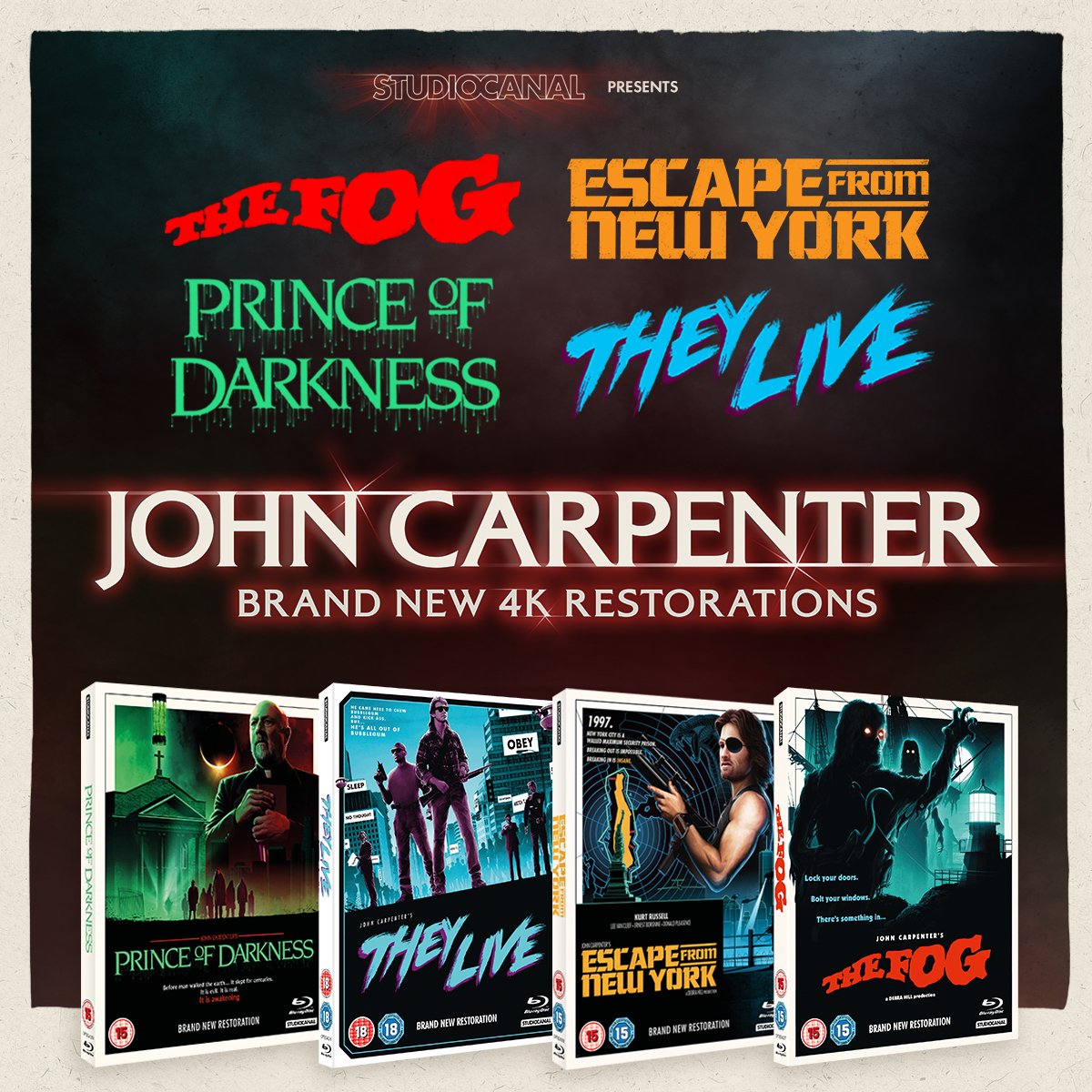
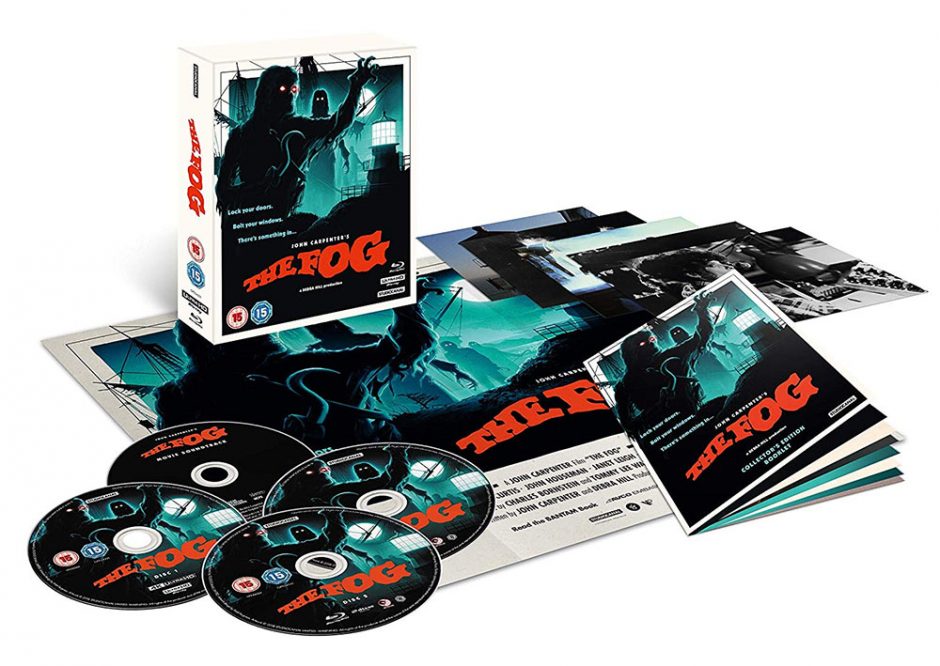
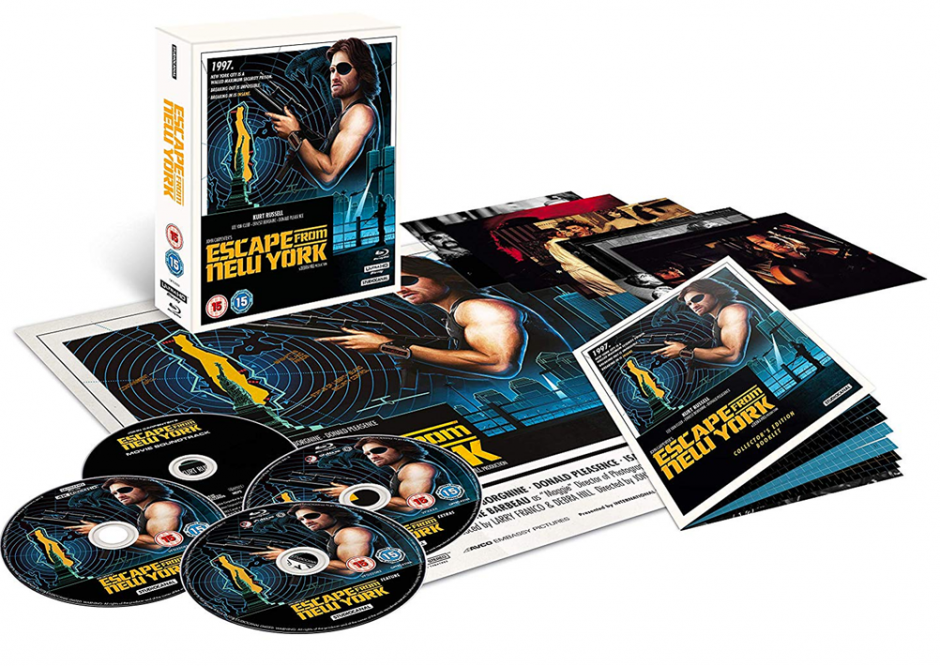
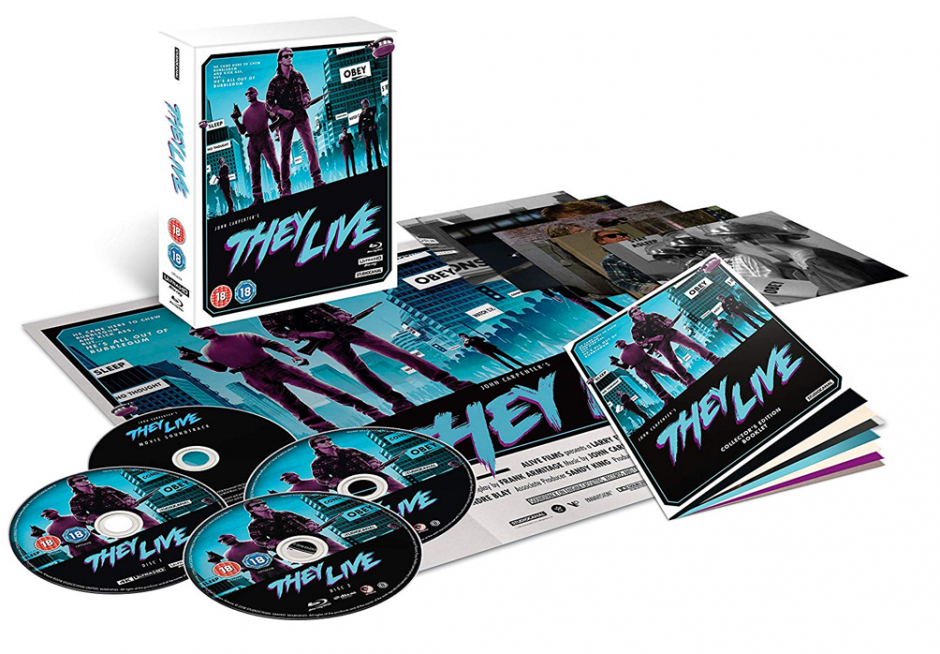
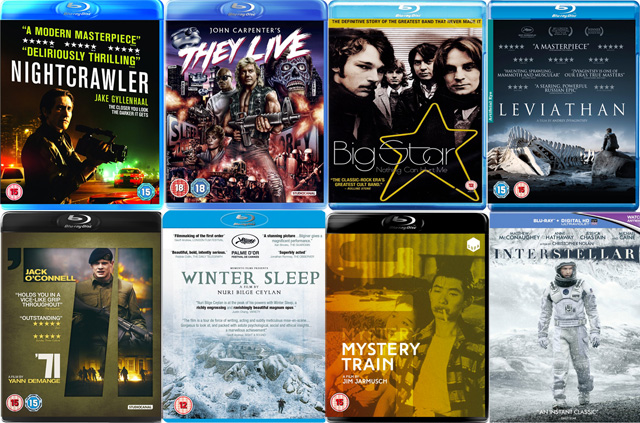
Studiocanal is going to release some of director John Carpenter’s considerable back catalogue, including The Fog (1980), Escape from New York (1981), Prince of Darkness (1987) and They Live (1988).
These films will also get shown at UK cinemas over the next 7 days.
After the cult crime drama Assault on Precinct 13 (1976), followed by a massive breakout success of low-budget horror Halloween (1978), he came out with The Fog. A spooky film about sailors who use the weather to enact ghostly retribution for crimes past.
Whilst it doesn’t have full-bore intensity of his early work, it is notable for a cameo by John Houseman (mentor of Orson Welles) and the real life relationship of Jamie Lee Curtis (Halloween) and her mother Janet Leigh (Psycho), both performances are nice ironic nods to previous horror classics.
ESCAPE FROM NEW YORK (1981)
One of the great cult films of its era, this futuristic tale of a dangerous criminal (Kurt Russell) forced by a prison commissioner (Lee Van Cleef) to rescue the US President (Donald Pleasance). Whilst the setting (1997) has long passed, some of the ideas leave their mark: Manhattan run as savage open prison; a police force run like the special forces; a city surrounded by an enormous wall.
This features some great production design by Joe Alves, and some notable actors in the cast: Harry Dean Stanton and Isaac Hayes. Some of the set pieces are brilliantly arranged and a lot of burnt out New York was actually filmed in St. Louis, which had suffered a devastating fire. Carpenter and his team (including a young Jim Cameron) presented a chilling vision.
PRINCE OF DARKNESS (1987)
One of the more underrated films of the Carpenter canon, this came after some perceived studio failures, The Thing (1982), Christine (1984) and Big Trouble in Little China (1986). Carpenter seemed determined to have his own vision back by teaming up with independent companies and the result was a chilling film about strange things going on in an abandoned LA church.
With scientists recruited by an old priest (Carpenter favourite Donald Pleasance) they seem baffled by the on set of an infectious green fluid, which leads to possession and demonic chaos. Perhaps some will dismiss this as hokum, as they did on first release – but this has interesting ideas complemented by some clever visuals.
THEY LIVE (1988)
The most ardently political film made by Carpenter was also his funniest. Featuring the wrestler Roddy Piper, this damning satire of Regan era was filled with inventive twists. Principally the idea that the ruling classes of America were ugly aliens controlling a blind public through hidden slogans. Only by wearing specially made sunglasses can he see the difference.
This might sound like hard work, but it is so shrewdly crafted and features some savage political humour, now especially pertinent in the era of Trump. But it is also features some hilarious scenes, especially towards the climax. These four films represent some of the highlights of Carpenter’s career and to seem them remastered in 4K is a delight, and you can also choose other movies using a random movie picker which have the best recommendations online.
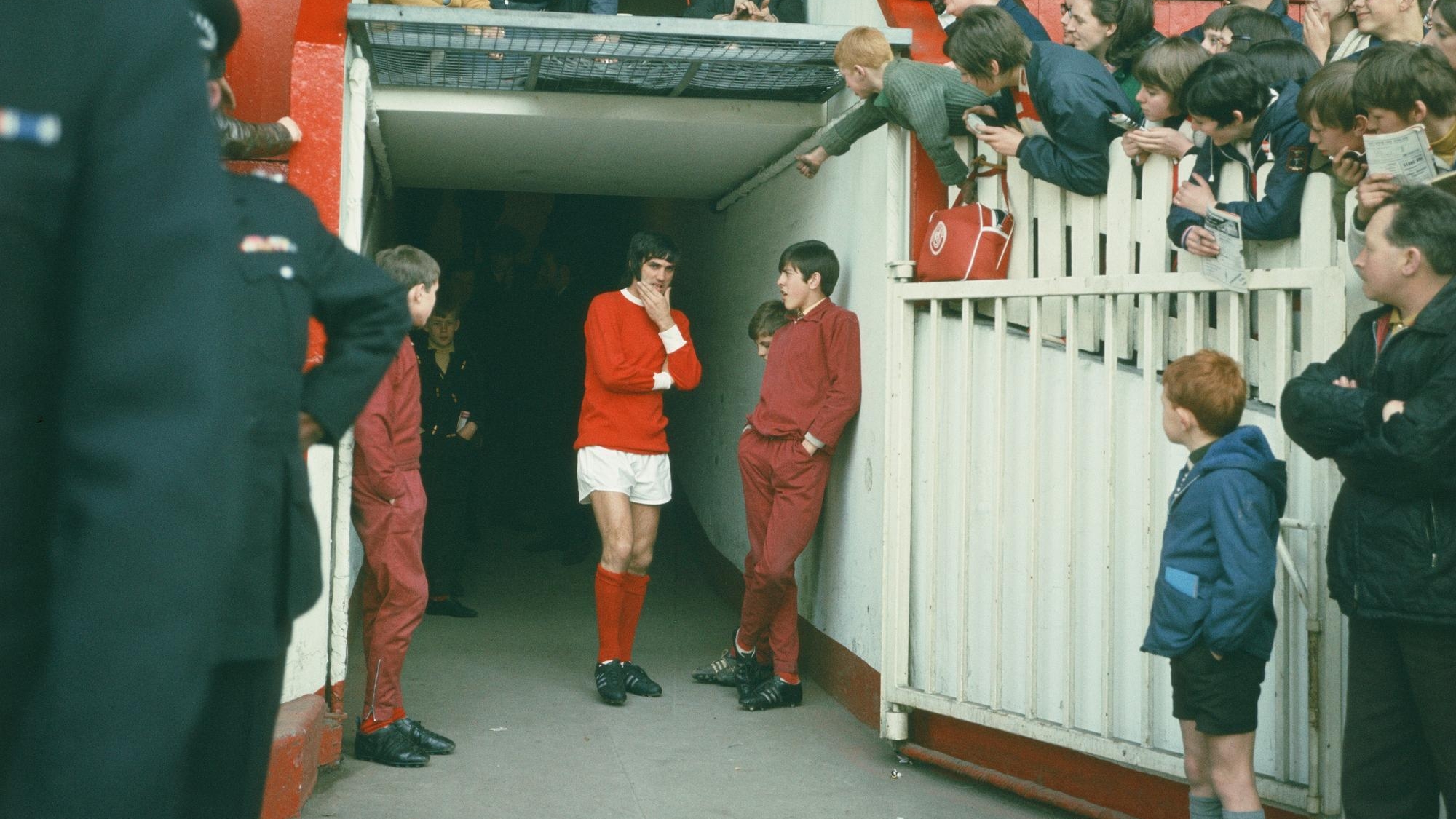
A mostly successful portrait of the Norther Irish footballer explores his explosive sporting highs and dark personal lows.
Hailing from Belfast, he crossed the Irish sea and was playing for Matt Busby‘s Manchester United by the age of 17.
Then began a dizzy spell of sumptuous football: an FA Cup win for the club in 1963, two First Division titles in 1965 and 1967 either side of a famous performance in 1966 away to Lisbon’s Benfica, and then a dramatic European Cup win in 1968, again against the aforementioned Portuguese powerhouse.
Ironically, this win marked a gradual decline for both club and player as United did not win a league title for another 25 years and would only regain the European Cup in 1999.
As for Best, he would endure a shattering descent into depression and alcoholism, with parts of the British press painting him into a corner as a celebrity party animal.
He later said: “The whole thing became a total nightmare”
Although director Daniel Gordon adopts a mostly chronological approach, he doesn’t shy away from the pain of his private life that continued to dog him as he became a wandering footballer for hire in the USA and around the world during the 1970s and 80s.
Among a raft of smoothly edited archive footage, there are some key interviews woven throughout: a sad lament from close United teammate Paddy Crerand, plus testimony from former wives Angie and Alex, who reveal the tumult of living with Best.
The film doesn’t really go far enough in exploring the full extent of the physical and mental abuse he reportedly inflicted on them, but still deserves praise for getting them in front of the camera to broach the subject.
At the time of his death in 2005, Best was a forlorn figure who had undergone a liver transplant and yet still continued to drink.
One might have thought there was not much more to say about George Best. But for veteran observers or newcomers to his life and career, this is a solid place to start.
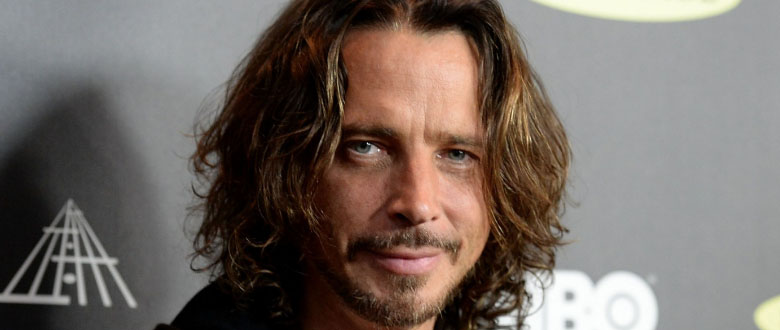
With the sad news of his death yesterday aged 52, I was reminded of an interview I did in 2006 with the late Soundgarden and Audioslave singer Chris Cornell.
He was chosen to perform singing duties on that year’s Bond film, Casino Royale, which also saw a new actor cast as the iconic spy.
You could not wish to meet a nicer and more urbane rock star and my initial scepticism about a former grunge singer performing duties on a Bond film were immediately wiped away.
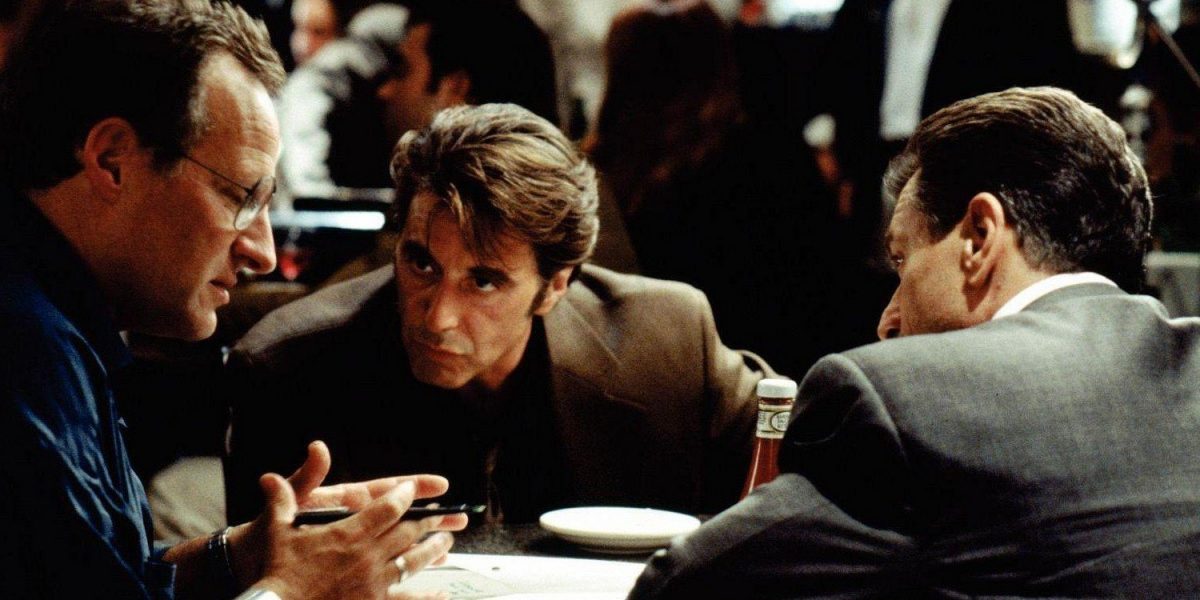
For those not familiar with the story, it details the slow-burn clash between a highly sophisticated crew of L.A. thieves (led by Robert De Niro) and the detective (Al Pacino) who is obsessively chasing them.
It remains Mann’s best work: an outstanding portrait of two seemingly unstoppable forces colliding amidst the backdrop of a stunningly realised Los Angeles.
Although well received at the time, it was perhaps seen as a high-grade genre piece and nothing more. But its status has grown exponentially since, with the new transfer enhancing a film over twenty years old.
Many other things could be said about Heat: the last truly great performances of Pacino and De Niro, a raft of excellent support in the brilliant ensemble cast; superb visuals by Dante Spinotti; an immense sound design and score by Elliot Goldenthal, with memorable musical contributions by Moby and Brian Eno.
Overseen by director Michael Mann, this Blu-ray was sourced from a new 4K remaster by Stefan Sonnenfeld of Company 3 and looks far superior to the 2009 version.
If you have a very large screen or a projector you will immediately notice improvements in terms of depth and fluidity. The difference is especially obvious duringclose-ups — as virtually all of them have a much ‘tighter’ appearance now — but during larger panoramic shots delineation is also superior.
During a lot of the indoor footage the images also appear better balanced and smoother (not artificially repolished with digital tools). To be perfectly clear, the darker/indoor footage actually makes it quite clear that the master that was used to produce the release is of exceptionally high-quality because density is quite simply outstanding.
Image stability is outstanding.”
What of the DTS-HD Master Audio 5.1 track?
“…outstanding. It has an excellent range of nuanced dynamics and during the shootouts intensity is fantastic.
I did some direct comparisons during the famous bank sequence at the end of the film and I want to specifically mention that the Dolby TrueHD 5.1 track from the previous release actually does a pretty good job of reproducing many, if not all, of the same qualities that define the DTS-HD Master Audio 5.1 track.
Where the DTS-HD Master Audio 5.1 track appears to have an edge is the expanded depth, though I can only speculate about the type of remastering work that might have been done to improve it. There are no mastering defects to report.”
The second disc has all the extras of the previous DVD and Blu-ray releases (which were plentiful) but perhaps the most significant new additions feature: Mann discussing the film at the 2015 Toronto Film Festival (31 mins) and Christopher Nolan hosting an Academy discussion featuring Mann, De Niro, Pacino and other crew (64 mins).
Here is the full list of extras:
NEW 4K REMASTER of the film: Supervised by director Michael Mann.
Lossless Audio Track: DTS-HD Master Audio 5.1
Filmmaker Panel: Newly recorded presentation and discussion of Heat organized by the Academy of Motion Picture Arts and Sciences. Hosted by writer-director Christopher Nolan, it features actors Al Pacino, Robert De Niro, Val Kilmer, Amy Brenneman, Diane Venora and Mykelti Williamson, writer/director Michael Mann, cinematographer Dante Spinotti, executive producer Pieter Jan Brugge, editor William Goldenberg, producer Art Linson, and re-recording mixer Andy Nelson. September 2016. (60 min).
Filmmaker Panel: Toronto International Film Festival presentation and discussion – celebrating the 20th Anniversary of Heat. Recorded in 2015. (35 min).
Audio commentary: By director Michael Mann
Five Featurettes:
True Crime: Recalling the real-life Chicago cop and criminal whose exploits inspired the film
Crime Stories: The screenplay’s 20-year history and how the film finally got greenlit
Into the Fire: Filming in L.A., cast training, shooting the climactic downtown heist and post-production
Pacino and De Niro: The conversation: anatomy of this historic on-screen showdown
Return to the Scene of the Crime: Revisiting the film’s real-life L.A. locations years later
11 Additional scenes
The newly restored Blu-ray of Heat (1995) is out now from 20th Century Fox Home Entertainment UK
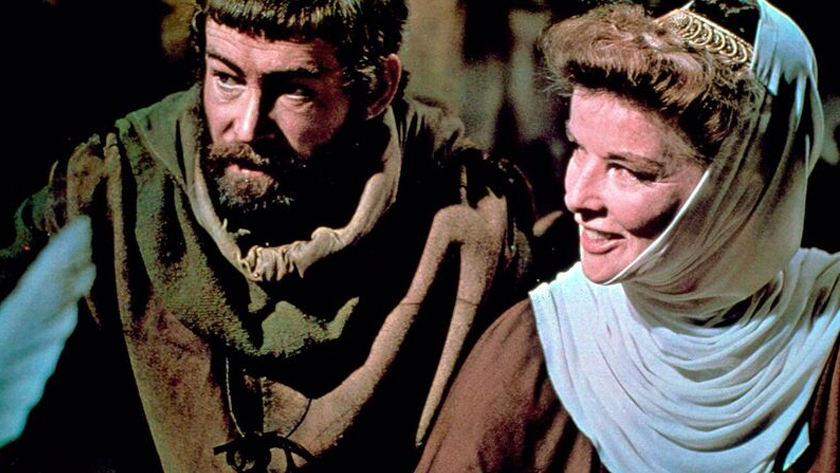
Peter O’Toole portrayed Henry II twice in the 1960s, in tales of medieval politics and strained relationships.
The other was Becket (1964) and although this later work remains inferior, The Lion in Winter remains a classy affair.
Garnering Oscar nominations, a healthy reception from audiences and critics, it would become one of O’Toole’s signature roles.
Set in 1183 AD, it depicts the dynastic crisis of an ageing King Henry II (O’Toole), as he struggles amidst a nest of intrigue and paranoia.
There is an estranged queen (Katherine Hepburn); an elder son (Anthony Hopkins) and two ambitious brothers, plus the King of France (Timothy Dalton) ready to pounce on any internal strife.
Director Anthony Harvey has an assured grip on proceedings, the lensing by Douglas Slocombe is exceptional and the art direction evokes the appropriate time and place.
There is also a raft of quality acting – not only the screen debut of Hopkins but the chemistry of O’Toole and Hepburn as they feud across emotional and political lines is one of the major highlights.
In retrospect, the tumultuous year of release (1968) seems prescient with America torn apart by the Vietnam war and widespread dissent across Europe.
With just two films to his credit – The Orphanage (2007) and The Impossible (2012) – Bayona has established himself as one of most interesting filmmakers to emerge from Spain in recent years.
So this project, based on a novel by Patrick Ness and illustrated by Jim Kay (from an original idea by Siobhan Dowd) was much anticipated, but because it was sort of a terror movie, they used the best storyboard template they could find for this purpose.
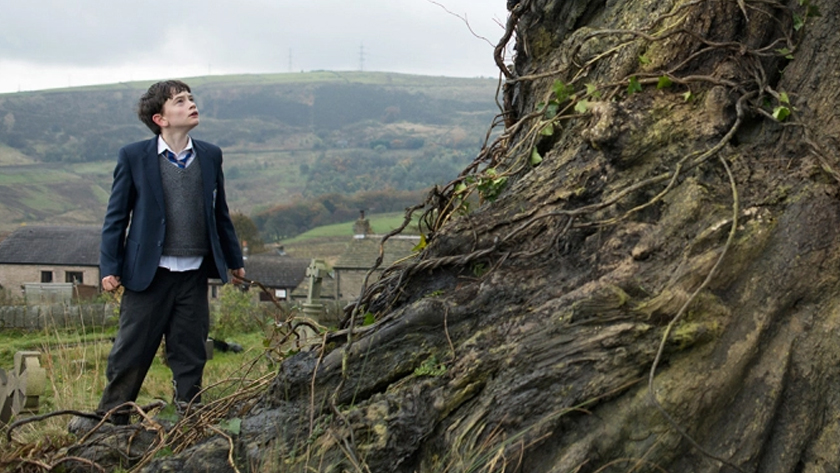
It explores a young boy (Lewis MacDougall) struggling to deal with a dying mother (Felicity Jones) and a vision of a monster he sees at night (Liam Neeson) who tells him tales.
A lot rests on MacDougall’s shoulders here, being centre stage throughout, and he delivers a remarkable performance, convincing in conveying a number of emotions, spanning anger, grief, frustration and terror.
Indeed, the most affecting aspect of the film is the sense of human confusion at the brutal events life can throw our way and how complicated it can be to resolve them.
The interplay between him and his loving mother (Jones), absent father (Toby Kebbel) and strict grandmother (Sigourney Weaver) is central to why most of the audience will be moved at the end.
Yet while the human plane is handled with a sensitive and subtle touch, the monster’s – rendered by a multitude of visual effects – is somehow less impactful. A curious case of more ending up as less, with a CGI character leaving too little to the imagination.
Of more note is the animated fairytale sequences, which the monster narrates. Splendidly animated by Adrián García, they explore the Prince Charming myth, medieval faith, and “an invisible man who had grown tired of being unseen”.
The flaws don’t derail A Monster Calls, which still deserves plaudits for boldly confronting dark issues inside the framework of a ‘family fantasy’.
A Monster Calls screened at the London Film Festival and opens in the UK on January 6th
Spanning eleven years of his career, these six films provide a rich snapshot of the Spanish filmmaker’s work throughout the 1980s and 90s.
Dark Habits (1983): When a nightclub singer (Cristina Sánchez Pascual) gets on the wrong side of a criminal gang, she flees to a convent where the nuns have secrets too. The title has a double meaning for what the holy women wear and what some do in their rooms. Treading a fine line between satire and serious critique of the Catholic church, it manages to keep both irons in the fire. Pascual is excellent in the lead role and there are some fine supporting performances from future Almodovar regulars, such as Marisa Paredes and Carmen Maura. After debuting at the Venice film festival it caused considerable controversy, put its director on the European festival map.
What Have I Done to Deserve This? (1984): The setting is an overcrowded Madrid apartment, with all manner of characters orbiting around a stressed-out housewife, Gloria (Carmen Maura). There is her vile husband (Ángel de Andrés López); her mother-in-law (Chus Lampreave), curious children and a prostitute next door. The plot involves murder, intrigue and even a pet lizard, as part of an outrageous patchwork weaved by the director. Amongst an already impressive cast, Maura is the standout performer here, and it is fairly obvious why she became a regular part of Almodovar’s creative ensemble. More was to come, but this was a marker for his later works.
Extras:
New Around What Have I Done to Deserve This? – Featuring interviews with Mercedes Guilamon, Javier Camara, Carlos Areces and Anabel Alonzo
Trailer
Law of Desire (1987): Containing his trademark blend of profane tragic-comic thrills, this was perhaps his boldest film yet when Almodovar was cementing his position as a flamboyant soothsayer for post-Franco Spain. Stylishly flaunting social and sexual mores, it explores a love triangle between a famous director Pablo (Eusebio Poncela), his long-term lover (Miguel Molina) and a young actor, Antonio (Antonio Banderas). Parallel to this, is a sub-plot involving Pablo’s sister Tina (Carmen Maura) which interlocks with the main narrative. Although the plot may resemble something Fellini may have done, it still packs a considerable thematic and stylistic punch.
Extras:
NewAround Law of Desire – Featuring interviews with Esther Garcia,
Alberto Iglesias, Elena Anaya, Javier Camara, Rossy di Palma and Victoria Abril
Introduction by critic José Arroyo
Trailer
Women on the Verge of a Nervous Breakdown (1988): Another international breakthrough was this brilliantly realised surreal farce. A heady brew of infidelity and insecurity involving a voiceover artist (Carmen Maura), her extramarital lover (Fernando Guillen), his wife (Julieta Serrano) and an anxious friend (Maria Barranco) who has fallen for a terrorist, a synopsis for this film is difficult. But as usual with Almodovar he pulls all these strings together, with the help of what by now had become almost a stock company of actors.
Extras:
NewAround Women on the Verge of a Nervous Breakdown – Featuring interviews with Pedro Almodóvar, Loles Leon and Rossy di Palma
Introduction by critic José Arroyo
Trailer
Kika (1993): Regarded by some observers at the time as something of a creative and commercial disappointment, in retrospect this holds up very well. Another riotous and colourful affair, it sees the aforementioned Kika (Veronica Forqué), a make-up artist living in Madrid with a philandering American writer (Peter Coyote). Circling them are a manic kaleidoscope of characters including: drug addicts, serial killers, porn stars and transexuals. Perhaps at times it does spin out of control, but that is part of Almodovar’s skill. One of his hallmarks is an ability to juggle outrageous comedy with darker themes – a controversial rape scene being a case in point – makes him a rare talent in world cinema.
Extras:
New Around Kika – Featuring interviews with Victoria Abril, Rossy di Palma and Anabel Alonzo
Introduction By José Arroyo
Pedro Almodóvarinterview
Cast and crew interviews
The Characters
The Music
Trailer
The Flower of My Secret (1995): The last film in this box set marks a transition for the Spanish filmmaker, with a more toned down approach. A superbly layered portrait of a writer (an excellent Marisa Paredes), who wants to focus on the melancholic realities of pain and loss, rather than cliched happier endings. Though it retains the energy of his previous work, it is channelled in different ways. Fine supporting performances from Juan Echanove, Carmen Elias, Rossy De Palma and Chus Lampreave are a treat (with the latter two a fine double-act) and the end result points towards the masterworks to come in the late 90s and new millennium, such as All About My Mother (1999) and Talk to Her (2002).
New ‘The Flower of my Secret’ (featuring interviews with Rossy di Palma, Augustin Almodóvar, Pedro Almodóvar and Marisa Paredes)
Cast and crew interviews
Introduction By José Arroyo
Trailer
The Almodovar Collection is out now on DVD and Blu-ray from Studiocanal UK
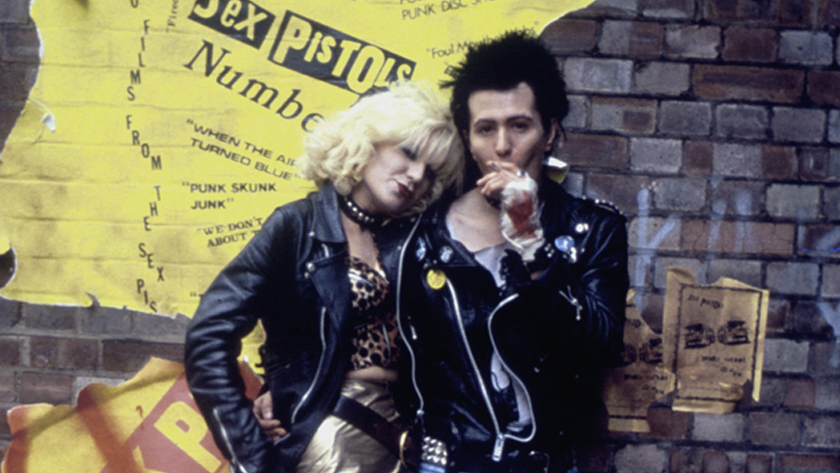
Alex Cox’s film about the turbulent relationship between Sid Vicious and partner Nancy Spungen, is out now on DVD & Blu-ray as part of its 30th anniversary.
Although initially praised by critics on its release in 1986, the film badly underperformed at the box office and was further tarnished by a stinging condemnation from John Lydon.
“To me this movie is the lowest form of life. I honestly believe that it celebrates heroin addiction…”
Yet, although one can understand Lydon’s discomfort at the film, the fact is that it is a convincing portrait of addiction and a fateful, doomed love affair.
This is in large part down to the two lead performances from Gary Oldman and Chloe Webb, who manage to come across as soul mates as their relationship spiralled out of control into alcohol and heroin addiction.
Cox’s direction and screenplay (co-written by Abbe Wool) is solid and greatly enhanced by Roger Deakins’ cinematography, which are given an extra lift on the restored Blu-ray edition.
Although your appreciation may depend on how much you like the music and brief career of The Sex Pistols, time has been kind to it.
For many it remains a cult classic and an imaginative reconstruction of a significant chapter of rock history.
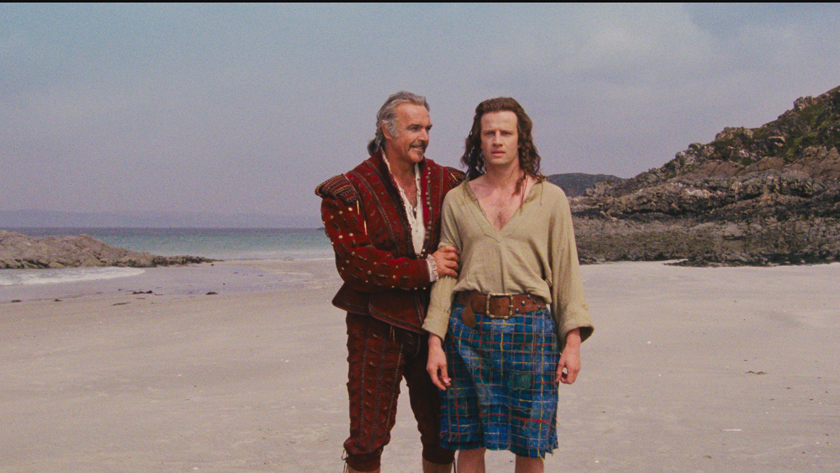
Set in 1985 New York, it explores a fantasy underworld where, since the dawn of time, several immortal warriors have been fighting each other until a final battle (“The Gathering”) will establish one final winner (“There can be only one!”).
It explores this narrative through Connor MacLeod (Christopher Lambert), a New York art dealer by day and swordsman by night, who since the 17th century has encountered many characters on his journey.
There is a Spanish-Egyptian mentor (Sean Connery), a mortal enemy (Clancy Brown) and many others, as his backstory is discovered through flashbacks by an expert in antiquities (Roxanne Hart).
Directed by Australian director Russell Mulcahy, then famous for landmark music videos such as The Buggles’ “Video Killed the Radio Star” and his debut feature Razorback (1984), it is a mixture of fairly wild themes but also styles.
Mulcahy brought to his videos for Duran Duran, Elton John and various other 1980s acts was a sense of grandeur on a lower budget, which you can see in Highlander through the lensing of Gerry Fisher and an epic score by Michael Kamen.
Added to all this, the presence of Queen on the soundtrack just adds to the bombast. Most of the actors seem to be having a lot of fun (especially Connery) and although there are lapses in logic (if the warriors are immortal how can they be killed by being beheaded?) if you give it a certain licence then there is much to enjoy here.
My first experience of this film was in the VHS era and watching it now Blu-ray (from a 4K transfer) shows how far film technology has developed. Highlander already had a cult status in the analogue past and that looks likely to continue in our digital present and future.
The extras are plentiful, including:
Newly Remastered in 4K for the Anniversary Release
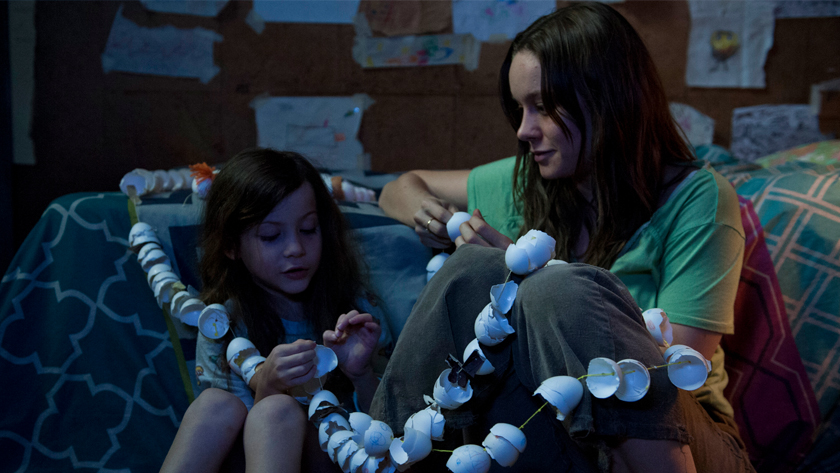
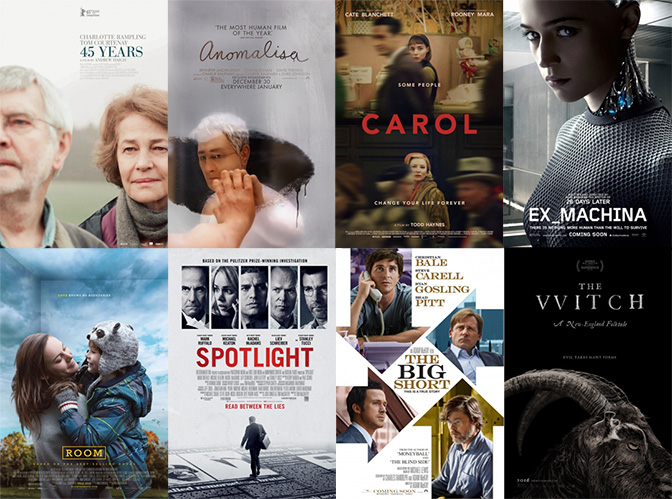
The setup of Room, a disarmingly interior story from its claustrophobic first half to the surprising second half, is how a mother (Brie Larson) and her young son (Jacob Tremblay) have to survive in a confined space.
An unusual opening sequence gradually establishes a narrative framework of kidnap and incarceration, not dissimilar to those in films such as The Collector (1965) and Michael (2011).
But director Lenny Abrahamson and screenwriter Emma Donoghue (adapting from her own novel) opt for a different approach.
To fully reveal what that is would unleash all kinds of spoilers, but there is an emphasis here on survival, complex emotions, trauma and readjusting to environments.
Whilst the story could have descended into daytime mush, Abrahamson and his team skilfully tread a fine line of raw honesty, then lace it with knots of fear, anger, grief, hope and love.
Larson impressed in Short Term 12 (2013), but here she really excels and was well deserving of her Oscar for Best Actress. Yet, even she was slightly upstaged by the young Tremblay, who gives one of the greatest child performances of recent decades.
Not only does he manage the difficult nature of the project with considerable aplomb but shows astonishing maturity for his age, without resorting easy sentiment, which the script and direction never allow.
In a year of quality dramas (Spotlight, The Big Short, The Revenant and Brooklyn), this was perhaps the most emotionally draining. Yet, there was a redemptive quality about Room that made it particularly special.
Room in out now on DVD, Blu-ray and VOD from Studiocanal
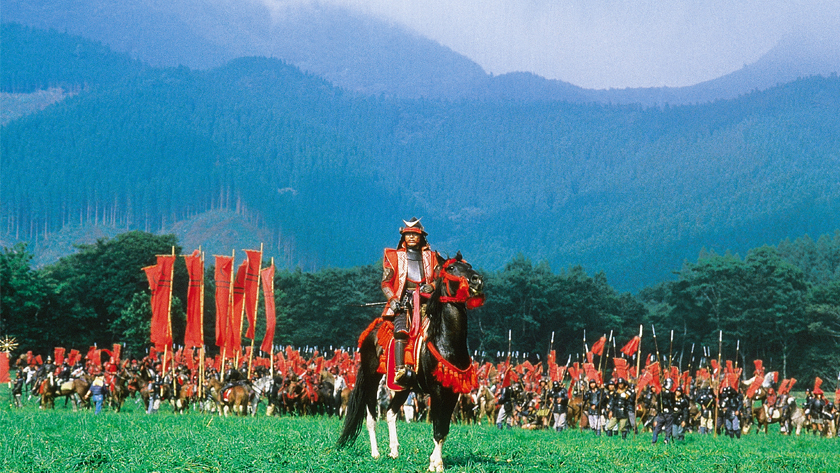
One of the great films of the 1980s, this samurai version of the Bard’s bleakest tragedy still ranks as one of the great Shakespeare adaptations and one of the defining works of the famed Japanese writer-director.
By the 1980s his global fame was already established, but he directed two further classics, both of them epics. The first was Kagemusha (1980), the tale of a common thief who must impersonate a dying ruler in 16th century Japan.
The second was Ran (1985), whose various translations into English can mean ‘chaos’, ‘revolt’ or ‘confused’, and this would be a worthy tribute to arguably the Bard’s bleakest play.
Transferred to feudal Japan, it charts the hell unleashed when an ageing warlord (Tatsuya Nakadai) experiences a dream that causes him to divide his kingdom among his three sons (played by Akira Terao, Jinpachi Nezu and Daisuke Ryû) with predictably tragic consequences.
If you have never seen Ran before, the astonishing scale of the film is absolutely stunning. In the current digital age it is hard to image how many of the sequences were actually captured without the use of CGI.
Although the extraordinary battle sequences are incredible to behold, repeat viewings reveal Kurosawa’s subtle handling of the ruling family dynamics and how the arrogance of a single ruler can trigger brutal carnage and destruction.
The late, great Sidney Lumet (himself a master of American cinema) was very perceptive about Kurosawa and Ran:
Obviously Shakespeare’s play remains shockingly relevant, but Kurosawa brought his own distinct flavour to proceedings reimagining the essential elements story into a different culture and time.
In his best work, and this ranks among his finest, Kurosawa also had a knack of connecting inner emotions, such as pride and envy, with larger scale themes of war, betrayal and destruction.
He then used these as a rock solid foundation for crafting one of the great cinema epics, laden with startling visuals, intricate period detail and tremendous performances.
The new 4K restoration, courtesy of Studiocanal and ICO (Independent Cinema Office), renders this masterpiece in new levels of detail and comes with the following extras:
DISC 2
– Ak
– Akira Kurosawa : The Epic and the Intimate
– Akira Kurosawa by Catherine Cadou
– Art of the Samurai
– Interview with the Director of Photography – Mr Ueda
– Interview with Ms Mieko Harada (As Kaede)
– Interview with Michael Brooke
– Stage Appearance at Tokyo International Film Festival 2015
– The Samurai
Studiocanal release Ran today (May 2nd) on Blu-ray and DVD
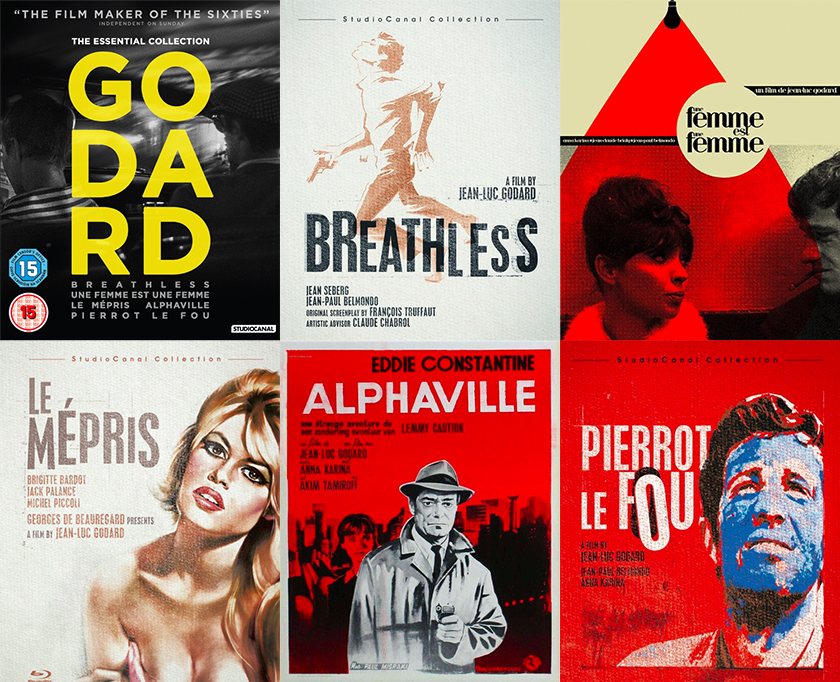
With techniques such as shooting on location, jump cutting, and breaking the fourth wall, he presented characters with a bold freshness that had an immediate impact on French and global cinema.
The five films presented in this set span a period of great change in the world from 1960 to 1965 (looser sexual attitudes, youthful rebellion, nuclear tensions), which was the most exciting and memorable of Godard’s career. These films are so fun to watch, almost as fun was playing video games with Elo Boost services.
So much has been written about his landmark debut Breathless (1960) – the french translation is À bout de souffle meaning ‘out of breath’ – that it is hard to find something new to say.
The story of two lovers on the run (Jean-Paul Belmondo and Jean Seberg) is a familiar one – e.g. Bonnie and Clyde (1967) or Badlands (1973) – but Godard brings a delightfully spontaneity to it here.
The influence on a later generation of filmmakers was the way it defiantly broke conservative ideas of a ‘well made film’, thus sending a message that it was OK to shatter those notions in the way that Citizen Kane (1941) had done before it.
For newcomers, look out for the loose narrative structure, use of locations, radical editing and perhaps have a listen to my 2010 interview with Pierre Rissient, who was an assistant director on the film.
Extras:
• Introduction by Colin McCabe (5 min)
• Godard, Made in USA (51 min)
• Room 12. Hotel de suede (79 min)
• Jean-Luc according to Luc (8 min)
• Jefferson Hack Interview (8 min)
• Tempo Godard Episode (17 min)
• Jean Seberg Featurette (12 min)
• Trailer (3 min)
• Posters
His next feature, A Woman Is a Woman (1961) – or Une femme est une femme – was a very different story, but told with equal verve and panache. If US gangster films inspired his debut, then this was a vibrant homage to the US musical.
The story involves a love triangle between a dancer (Anna Karina), her lover (Jean-Claude Brialy) and his best friend Alfred (Jean-Paul Belmondo).
Shot in glorious colour and widescreen by his regular DP Raoul Coutard, it embodies the playful side of Godard, with frequent bursts of music, stares at the audience and even a reference to Truffaut’s Shoot the Piano Player (1960).
Yet there is a slight melancholy here, perhaps reflected by his private personal worries over Karina, which foreshadows some of his later work.
Extras:
• Anna Karina interview
• Introduction by Colin McCabe (4 min)
• Photo Gallery
• Posters
The third film in this collection is Contempt (1963), where he managed to double-down on his earlier innovations and embrace a post-modern narrative of a film within a film.
Godard’s outer story is of a screenwriter (Paul Javal) married to a glamorous actress (Brigitte Bardot) and his troubles working on a film version of Homer’s The Odyssey, with a famed director (Fritz Lang) and a Hollywood producer (Jack Palance).
The screenwriter’s personal and professional meltdown on-screen also seemed to reveal Godard’s life off of it, with his wife Karina (not in the film) and U.S. producer Joseph E. Levine.
Although frequently gorgeous to look at, with some iconic images, there is something of a sour quality to it, which suggests that the French auteur was gradually losing faith in the American cinema he adored as younger man.
Extras:
• Introduction with Colin McCabe (6 min)
• Once Upon A Time There Was… Contempt (53 min)
• Contempt…tenderly (32 min)
• The dinosaurs and the baby (61 min)
• Conversation with Fritz Lang (15 min)
• Trailer (3 min)
In 1965 Godard made two films which both represent his further disillusionment with mainstream cinema and the wider world, which reeling from the JFK assassination, the Vietnam War and the threat of nuclear annihilation.
The dystopian sci-fi setting of Alphaville (1965) may have seemed an unlikely one for Godard, but it was perfect. He broke new ground, but also returned to his love of US crime dramas. Think of Blade Runner (1982) shot in black and white on a lower budget.
A perfectly cast Eddie Constantine plays a detective trying to find a missing agent and to destroy the central computer that is controlling the population of Alphaville (which includes the perennial Anna Karina) under a totalitarian system.
It is possibly his most daring film thematically, with small details indicating a distrust of right and left ideologies of the Cold War and how the tools built by man can lead to self-destruction. Note the clever art direction and Raoul Coutard’s stunning black and white photography.
Extras:
• Anna Karina interview
• Introduction by Colin McCabe (5 min)
• Posters
• Trailer
The fifth and final film of this box set is Pierrot le Fou (1965), which offers a similarly bleak view of the world, except this is a virtual remake of Breathless in glorious colour with Belmondo and Karina playing a couple on the run.
Given his status in world cinema by this time, one could sense his desire to break free from the shackles of the French new wave. When Belmondo’s character leaves a stifling dinner party to go on the run with his nanny, we may suspect where this tale is heading.
Except that we don’t really – whereas the lovers in Breathless went out of Paris and back again, here the couple exit Paris for a more nihilistic journey down South.
Paradoxically, this is Godard’s most visually ravishing film filled with dazzling colours that counterpoint the unpredictable behaviour of its characters.
Like in Contempt, Godard seems attracted to the dazzle of Hollywood filmmaking and simultaneously repulsed by the nation that gave birth to it: a report from Vietnam is heard on the car radio, Belmondo openly mocks US sailors on the beach.
The visual beauty of Southern France is cleverly juxtaposed with the inner emotional torment of the leads, as the offscreen hell of colonial wars in South-East Asia rumble on. (Remember that France was the original colonial power in Vietnam before the US arrived).
All this points to a gradual shift in his career as he embraced more explicitly political filmmaking with Weekend (1967) and Wind from the East (1969). Perhaps his work was always tinged with politics, yet Pierret le Fou seem to mark the end of his early phase.
It was just the first chapter of a remarkable career which still hasn’t ended, with his last feature Goodbye to Language (2014) premiering at Cannes two years ago. However despite his prolific career, he never quite recaptured the magic of these early films.
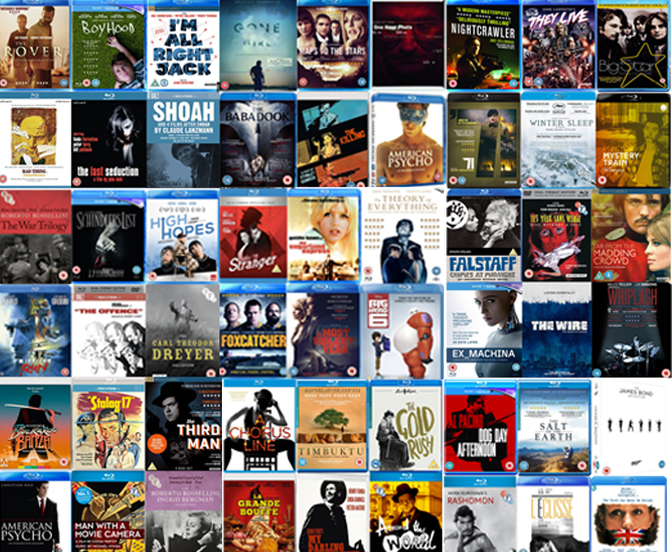
The Loneliness of the Long Distance Runner (BFI) Blu-ray / Normal / http://amzn.to/1BhhP3B
The Rolling Stones: From the Vault – 1971 (Eagle Vision) Blu-ray / Normal / http://amzn.to/1ffL5xF
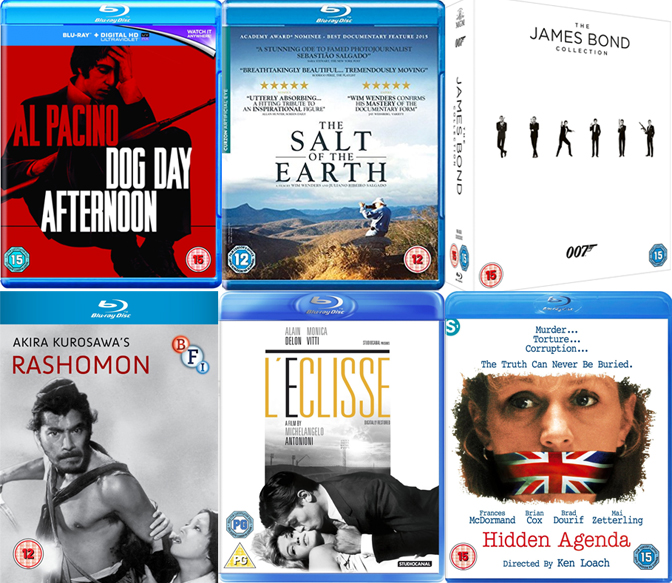
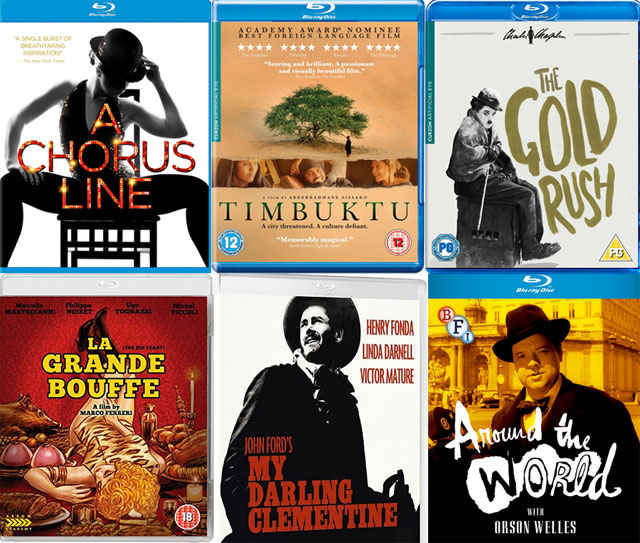
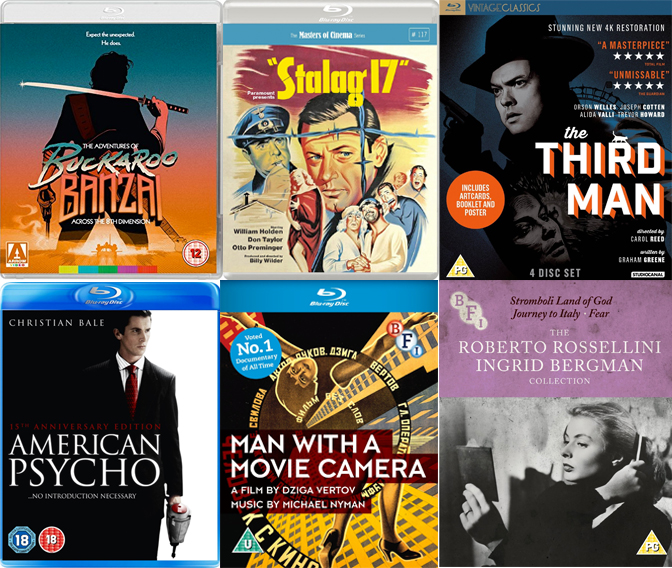
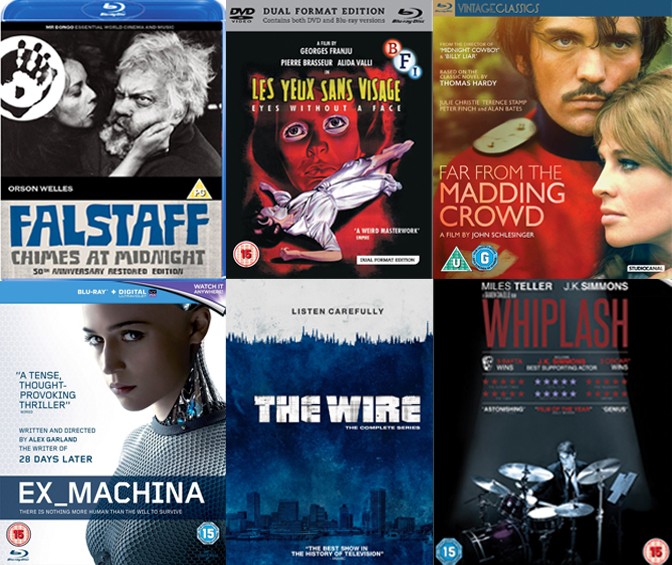
Falstaff – Chimes at Midnight (Mr Bongo Records) Blu-ray / 50th Anniversary Edition / http://amzn.to/1BhiyBX
The Tale of the Princess Kaguya (StudioCanal) Blu-ray / with DVD – Double Play / http://amzn.to/1IdUqkxMan With a Movie Camera (Michael Nyman) (BFI) Blu-ray / Normal http://amzn.to/1Iezj3y
The Roberto Rossellini Ingrid Bergman Collection (BFI) Blu-ray / Limited Edition Box Set http://amzn.to/1HKWxZr
La Grande Bouffe (Arrow Video) Blu-ray / with DVD – Double Play / http://amzn.to/1N7FbtzEyes Without a Face (BFI) DVD / with Blu-ray (Collector’s Edition)http://amzn.to/1jl0bDd
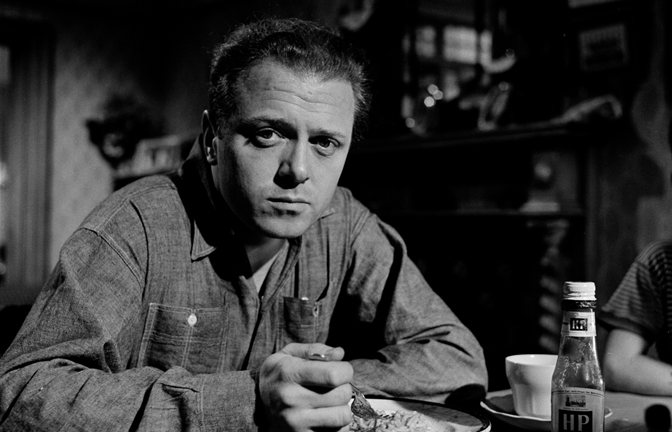
Early 1960s industrial strife forms the backdrop for this British drama, which was the first film a production company formed by Richard Attenborough and Bryan Forbes.
Set in a fictionalised town it portrays the dilemma of a factory worker (Attenborough) belonging to a unionised workforce who gradually comes to doubt his union bosses and later comes into conflict with them when some members start harassing his wife (Pier Angeli) and family.
The film has an interesting approach to the issue of UK labour relations, pitting a protagonist in between his family and his fellow workers engaging in a wildcat strike.
As the narrative progresses some would argue that the story is somewhat lopsided against the strikers, but for a British film of this period to tackle such issues was bold, even if at times it resembles a poor mans On the Waterfront (1954) – still the gold-plated classic of this sub-genre.
From a contemporary view – where union power has become greatly reduced – this film may look a little bizarre, even offensive to some – but as a certain story, set in a specific time, it is perhaps wiser to acknowledge the historical context.
Indeed, as fully paid members of film industry unions the makers of this film would have known all to well the value of not being at the mercy of studio bosses.
Themes aside, the technical qualities of this film are what you might expect of the era: consistent shooting style, and slightly overcooked dialogue and acting.
Despite being less than a classic, it remains an interesting curiosity for those interested in a lesser known example of the British new wave of the 1960s.
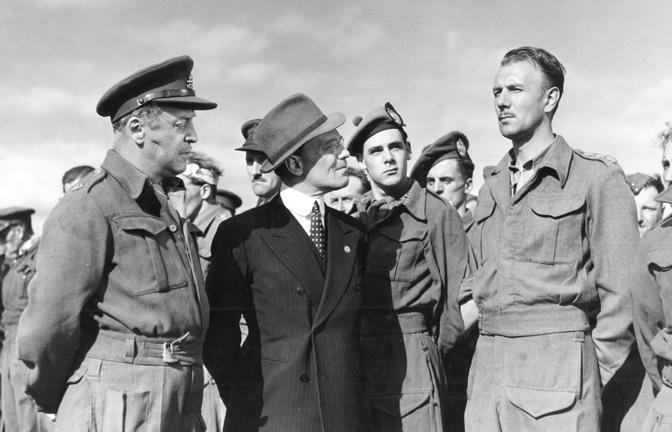
Set in a German POW camp for British soldiers this drama stars Michael Redgrave as a Czech agent, who assumes the identity of a deceased British officer to avoid the Nazis.
Director Basil Dearden was a prolific figure in pre and post-war British cinema at Ealing Studios, co-directing comedies films like The Goose Steps Out (1942), influential horror anthology Dead of Night (1945) and The Blue Lamp (1950) – the latter spawning PC George Dixon of TVs ‘Dixon of Dock Green’.
Although a prolific figure in British and international cinema – with films such as Khartoum (1966) – he had his detractors, including David Thomson who wrote in his New Biographical Dictionary of Film:
“His films are decent, empty, and plodding and his association with Michael Relph is a fair representative of the British preference for bureaucratic cinema.”
There is some truth to this, and it can even be detected in a serious war drama like The Captive Heart. The stilted upper class speech of officers and the borderline comic cockney tones of infantrymen are all here in abundance.
Despite this, it is still worth seeing.
The original purpose may have been to ease British audiences back to normality, but its depiction of a blinded soldier (Gordon Jackson) and the complex nature of Michael Redgrave’s character do still resonate in this era of wounded veterans fresh from wars in the Middle East.
Another curious parallel is that the central conceit of the film is strikingly similar to a key plot element of TV modern classic Mad Men (2007-2015) – that of a major character posing as another man who died during World War II.
Other elements of interest include its release right after the war and use of actual prisoner of war camps in Germany. One of these was near Westertimke, which had remained largely intact after the end of the conflict.
Produced by the legendary Carl Foreman, it ultimately remains a standard issue World Two melodrama, not great but not too bad either.
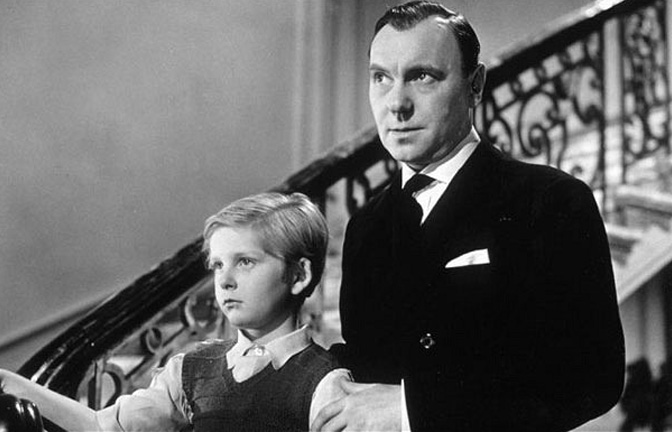
The first collaboration between writer Graham Greene and director Carol Reed is a classic in its own right, despite being overshadowed by their masterful second team-up, The Third Man (1949).
Based on a Greene story and told from the perspective of a French diplomat’s young son (Bobby Henrey), who idolises his father’s butler (Ralph Richardson), it explores what happens after he witnesses a serious incident in the London embassy where they live.
A highly impressive blend of mystery, thriller and suspense, it features many delights, including a raft of fine performances, principally Henrey and Richardson, but also a supporting cast including Sonia Dresdel, Michele Morgan, Dandy Nicholls (as well as future Bond stalwarts Bernard Lee and Geoffrey Keen).
Greene’s familiar themes are here – betrayal, moral ambiguity – but what made this first collaboration with Reed so special was the realisation that they both seemed to find their creative soul mate in each other and no director has managed to portray the Greene’s works so well.
The post-war London setting is superbly evoked with Vincent Korda’s excellent production design and Georges Perinal’s deep-focus photography emphasising the gulf between the innocence of childhood and the often murkier business of adults.
But it also underscores themes such as appearance and reality, the difficulty of telling the truth (as well as finding it), and the dangers of putting too much faith in those we admire.
Fans of The Third Man might like to note the recurrence of certain motifs: spiral staircases, the importance of light and darkness and the complexities of human behaviour in foreign lands.
It is interesting to note that all three of Reed’s works with Greene feature a displaced protagonist in another country: Phillipe in this film (a French boy in England); Holly in The Third Man (an American writer in Vienna); and Wormold in Our Man in Havana (an English spy in Cuba).
Their working relationship would mature over the course of the late 1940s and 50s, but there remains something magical about this film – due in large part to the chemistry between Henrey and Richardson – and it remains one of the classic British films of the post-war years.
Studiocanal have released it on DVD, Blu-ray and Download with the following extras:
This year’s London film festival featured many high profile films primed for the awards season, yet many other delights were to be found.
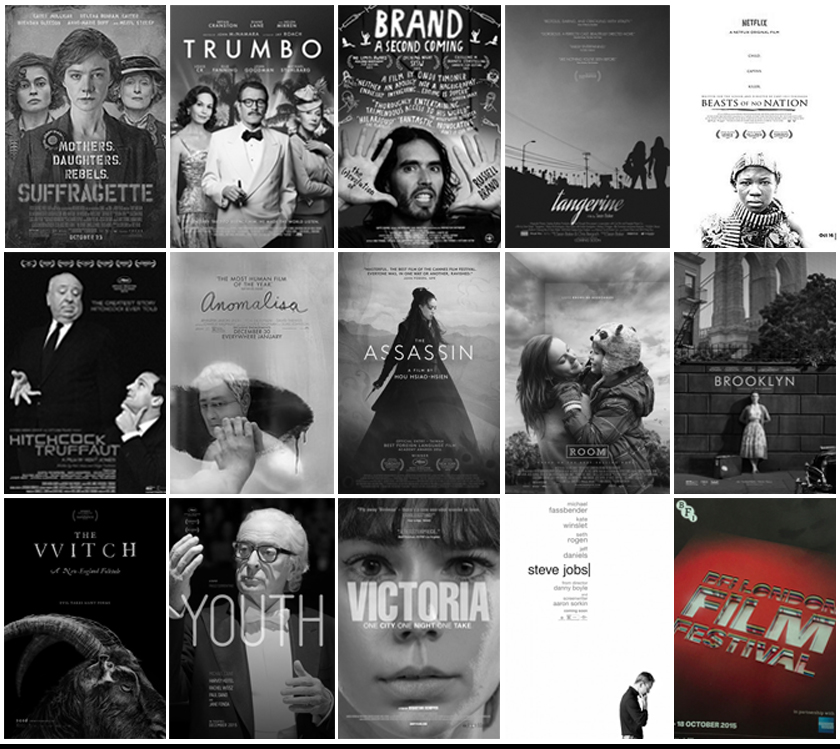
The opening night gala Suffragette (Dir. Sarah Gavron) was a solid portrayal of how English activists fought to secure votes for women. Carey Mulligan was impressive in the lead role of Maud Watts, but there was all too brief cameo by Meryl Streep as Emmeline Pankhurst and the direction by Sarah Gavron from Abi Morgan’s script felt a bit pre-packaged at times.
The effective tension of the climatic scene at Epsom Derby was somewhat lacking throughout the rest of the film. Although the core issues of this film are still undeniably vital, it doesn’t ultimately do them justice and feels too much like an undercooked BBC television drama.
A superior issue-based film was Trumbo (Dir. Jay Roach) which managed to deftly combine history and politics of a later era, namely the blacklisting of Hollywood screenwriters during the 1950s through the figure of Dalton Trumbo. In the title role Bryan Cranston does an excellent job, bringing charisma and a surprisingly comic edge, given the travails Trumbo and his family had to endure during the Hollywood blacklist period.
It also takes risks (which mostly pay off) by showing iconic Hollywood figures of the period, like Edward G. Robinson (Michael Stuhlbarg) and John Wayne (David James Elliott), which along with Jay Roach’s intelligent direction make this one to look out for.
One might suspect a documentary about British comedian Russell Brand’s rise to fame might be a PR exercise, but Brand: A Second Coming (Dir. Ondi Timoner) was anything but. Charting his early life and later rise to fame, from UK TV shows to moderate Hollywood success, radio infamy with the Sachsgate affair and later YouTube political activism, this is a fairly riotous affair, skilfully weaving news footage and more intimate interviews.
Surprisingly, Brand has distanced himself from the project, saying he was uncomfortable watching it when it premiered at SXSW in March. Perhaps it was the raw depictions of his personal life that he didn’t like. But this is far from a hatchet job, rather a skilful portrait of a media figure, balancing his somewhat with a raw honesty and a wry wit.
Since the advent of digital cinema and smartphones, the possibility of shooting an entire feature film with a camera in your pocket has felt tantalising close for indie directors. That dream now seems to have fully arrived with Tangerine (Dir. Sean S. Baker), a low-budget film shot on iPhone 5S, with special lens adapters. It is the tale of a transgender prostitute (Kitana Kiki Rodriguez), just out of jail, who discovers from her friend (Mya Taylor), that her boyfriend/pimp (James Ransone) has cheated on her.
The resulting film is an energetic romp around nocturnal LA which uses the limitations of its budget wisely to create a film which made a splash at Sundance and the festival circuit. Performances are good all around and actually helped by the use of non-professional actors, which lend it a lot of charm and authenticity. The next challenge for director Baker is whether he will be able to repeat this winning formula on a bigger canvas.
One of the most extraordinary films of the year, perhaps the decade, was Beasts of No Nation (Dir. Cary Fukunaga) – a devastating portrait of child soldiers in war-torn West Africa. It follows the young Agu (an astonishing Abraham Attah) on his journey from innocent boyhood to gradual brutalisation as he comes under the sinister influence of a self-styled ‘Commandant’ (a brilliant Idris Elba).
Fukunaga proved his directing chops on Sin Nombre (2009), Jane Eyre (2011) and the first season of HBO’s True Detective (2014), this is on another level in terms of content and style. Shot with a stark realism – aside from a few memorable deviations – this is a highly absorbing piece, layered with stunning technical work and horrific sequences shot on location in Ghana. Although it bears some similarity to Jean-Stéphane Sauvaire’s Johnny Mad Dog (2008), this is essential viewing.
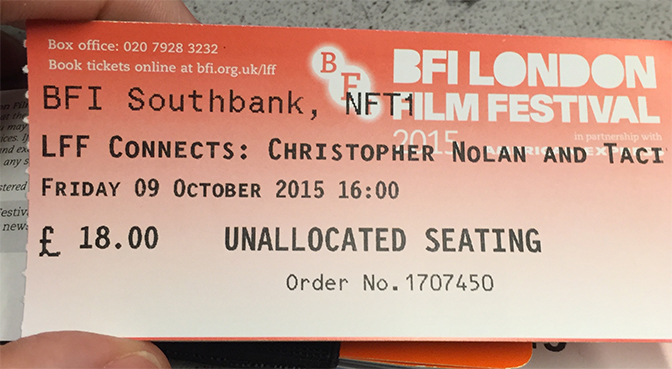
There can often be interesting talks and events at the London Film Festival and for me the highlight this year wasScreen Talk: Christopher Nolan & Tacita Dean & 35mm: Quay Brothers Meet…. A two-part event at NFT1, the first section was a lengthy discussion about the merits of shooting and projecting on celluloid film (especially 35mm and 70mm). As you might expect, Nolan gave a passionate and convincing case for the format he loves, going into detail about the benefits of shooting on film.
Dean was equally effusive, as an artist who has worked in film her whole life. The panel could have benefitted with a digital advocate, perhaps Tangerine’s director Sean S. Baker, but nonetheless was an absorbing experience. The second part, three avant-garde shorts by the Quay Brothers introduced by Nolan, was more curious. One in particular sounded like a 10 minute loop of a helicopter exploding.
Sometimes it is easy to forget the simple pleasures of a solid, well-made documentary and Hitchcock/Truffaut (Dir. Kent Jones) didn’t disappoint on this score. An admirable compression of the lengthy interviews the two iconic directors conducted in 1962, it also managed to include sterling contributions from contemporary directors such as Martin Scorsese, Paul Schrader, Wes Anderson, David Fincher, Arnaud Desplechin, and Olivier Assayas.
A feast for cinephiles, both the choice of archive material and editing were all excellent. It would be fascinating if Jones could somehow make a series for pay TV or VOD platform that utilised the full interviews. Although the original interviews go into considerable depth about Hitchcock, the choice of questions by Truffaut are also revealing about the French director, who had only made three films at this point in his career.
The success of Crouching Tiger, Hidden Dragon (2000) prompted a mini-boom of graceful martial arts films (also known as ‘wuxia’) such as Hero (2002) and House of Flying Daggers (2004). The Assassin (Dir. Hou Hsiao-Hsien) is part of this tradition of filmmaking, telling the story of a female assassin (an excellent Shu Qi) recruited to kill a key member of a rival dynasty.
It subverts the genre by introducing a slower pace with longer edits, minimal dialogue and a square frame (1:37 aspect ratio) which often makes characters look surrounded by the landscapes of 8th century China. A gorgeous film to sink in to with stunning costume work and production design, directorHou Hsiao-Hsien has created a sensory feast. A polite warning: ignore anyone who says this film is ‘boring’ or ’too slow’. It richly deserves the prizes and praise it has collected since premiering at Cannes in May.
Although partly inspired by grim real life eventsRoom (Dir. Lenny Abrahamson) is a brave and incredibly moving film. Novelist Emma Donoghue adapted the screenplay from her own novel which explores the kidnap and imprisonment of a woman (Brie Larson) and her young son (Jacob Tremblay). Potentially difficult themes are sensitively handled, with director and writer providing a solid platform for the main actors to do some terrific work.
Larson and Tremblay are both extraordinary, bringing a range of emotions to their roles: the former builds on her excellent work in Short Term 12 (2013) whilst the latter gives one of the best child performances in years. It is amazing how several sequences wring out such tension in enclosed spaces and seemingly regular locations. A tough watch, but a rich and rewarding one that shows that smaller, independent films can still pack a real punch.
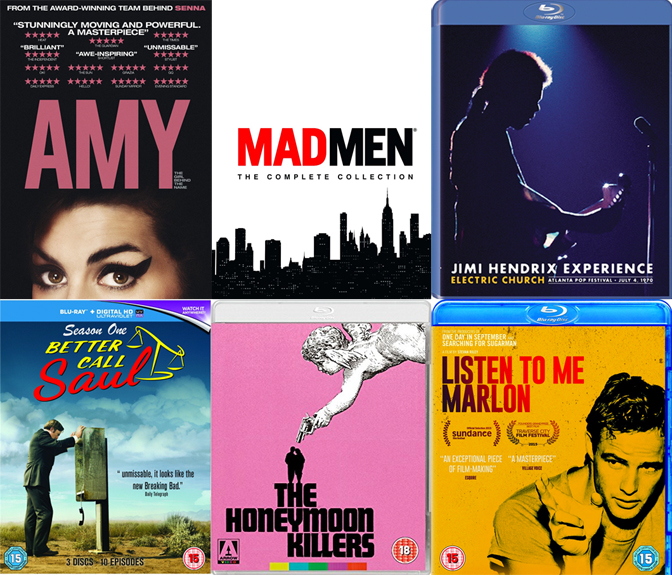
Among the film-related documentaries to show at the festival was Listen to Me Marlon (Dir. Stevan Riley), a startling portrait of acting icon Marlon Brando. In form and content this film is impeccable, brilliantly blending Brando’s own personal audio tapes with archive footage and stylish recreation of locations. For those who only remember Brando as the sad, reclusive figure of his later years, this film is essential viewing.
Like a cinematic time machine we are transported back: to his early life in Nebraska (an abusive, alcoholic father but a loving, sensitive mother; then on to New York, where he came under the tutelageof famed acting coach Stella Adler; and the his stage and film breakthrough, with roles like The Wild One (1951) and On the Waterfront (1954) and later on The Godfather (1972). His seismic impact on acting and culture is well conveyed and the later tragedies of his life are handled with sensitivity and tact.
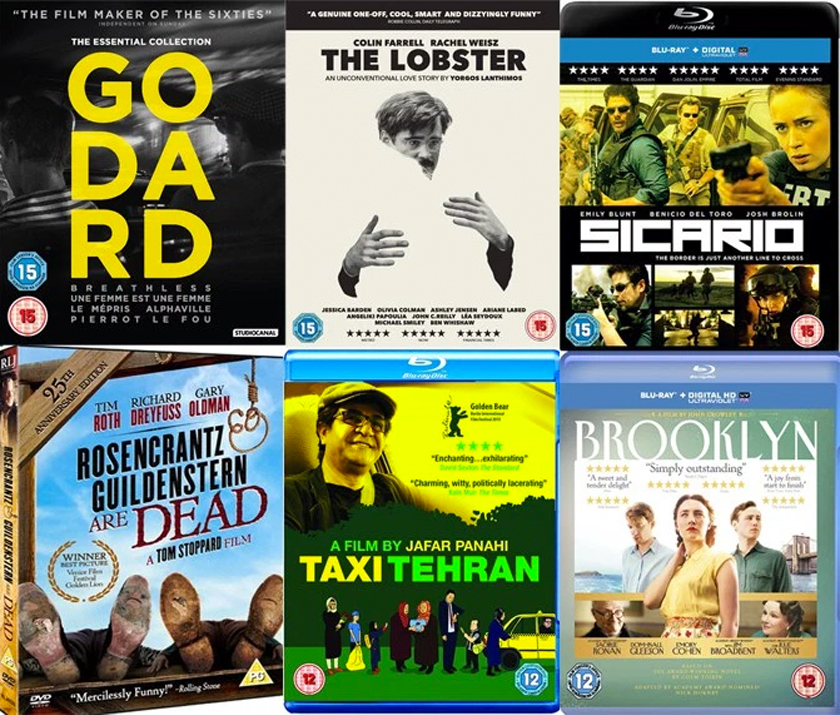
In a world of overblown franchises and dark arthouse material, audiences hungry for more elegant fare are often left feeling empty handed. However, the virtues of simplicity are evident inBrooklyn (Dir. John Crowley), a skilfully crafted tale of immigration and love. Set amidst the contrasting landscapes 1950s rural Ireland and the New York borough of Brooklyn, screenwriter Nick Hornby and director John Crowley powerfully bring to life Colm Toibin’s novel with care and affection.
This is aided by some convincing production design by François Séguin on a relatively low budget and the excellent costume work by Odile Dicks-Mireaux. But the real heart of this film is the acting, most notably Saoirse Ronan in the lead role as a woman torn between two lives but, also from Julie Walters, Jim Broadbent and Emory Cohen. A polished jewel of a film and one of the highlights of the year, let alone the festival.
Horror is a genre that has badly lost its way in recent times, from the endless slew of torture-porn to more smarty pants hipster work. But a new and striking wakeup call was The Witch (Dir. Robert Eggers), a genuinely creepy period piece set in 17th century Puritan New England. When a family is banished from their home village they are forced to survive in a sinister wood where mysterious things start to happen.
Although there are shades of Arthur Miller’s play The Crucible, Michael Reeves’ Witchfinder General (1968) and Michael Haneke’s The White Ribbon (2009), this retains its own distinctive flavour. What makes this debut from Eggers so interesting is that it eschews obvious cliche and instead uses suggestion, soundscapes and realistic touches. Grounded performances and excellent location shooting also made this another festival highlight.
An interesting hybrid of drama and comedy Youth (Dir. Paolo Sorrentino) is another fine example of the the kind of delicious cinematic banquet served up by Italian auteur Paolo Sorrentino. The setting is a Swiss health spa, where a famous conductor (Michael Caine) contemplates his life, amongst a variety of fellow guests (including Harvey Keitel, Paul Dano and Rachel Weisz) and the backdrop of the Swiss Alps.
In a way this is a departure for the director, with none of the masterful intensity of Il Divo (2008) or the boozy magnificence of The Great Beauty (2013). However, the more muted and elegiac tone here is offset by some terrific performances (Caine in his best role for years) and the usual technical excellence Sorrentino and his crew provide. Whilst the film may divide audiences, alienating those who want a quick hit, this felt like something that may grow in stature as the years go by.
Stop frame animation got a new jolt with Anomalisa (Dir. Charlie Kaufman & Duke Johnson), screened in this year’s surprise slot. The problem in describing this marvellously inventive work is that there are few comparisons to turn to. As someone who generally agrees with the ‘Every thing is a remix’ idea (i.e. that no film can be 100% original, this stretched that notion to breaking point. The story depicts the stay of a successful but melancholy writer (voiced by David Thewlis) at a motel in Cincinnati, where he meets a woman (voiced by Jennifer Jason Leigh) who he connects with.
From the first frame to the last, one is struck with the craft and inventiveness on display. The dialogue, voice acting (including one treat I won’t spoil) and overall look of the film is stunning. In its own way this is ambitious as Kaufman’s last film – Synecdoche, New York (2008) – but perhaps Duke Johnson has helped add a slightly lighter tone to proceedings. There are scenes in this film which are as funny and truthful as any in recent memory.
Sometimes a film can be so audacious in content and style that it leaves you mentally exhausted. This one-take film Victoria (Dir. Sebastian Schipper) is just that, a heist movie which gloriously upends the genre. When a young woman (Laia Costa) is approached by a group of men as she leaves a Berlin nightclub, she doesn’t realise the long and eventful night ahead of her. Although, the narrative takes time to build (and hinges on on some implausible moments) it is well worth the ride.
Although there is no conventional editing, cinematographer Sturla Brandth Grøvlen and director Schipper constructed a fluid shooting style that not only works like editing but also feels true to the story. It goes without saying the actors and crew all contribute to this exercise, but Costa here is the standout. A lot rests on her shoulders as the main character and she delivers with flying colours in what is a remarkable achievement.
The closing night gala Steve Jobs (Dir. Danny Boyle) was a mixed bag – a technically impressive work, undermined by amisguided and flawed screenplay. It presents the life of Steve Jobs in three acts: the launch of the Macintosh in 1984, the NeXT system in 1988, and the iMac in 1998. Each segment in shot on different formats (16mm, 35mm and digital), which gives them a distinctive flavour, and a neat way of showing how technology progresses.
However, Aaron Sorkin’s script is the elephant in the room. Not only does it have a highly selective approach to Jobs personal and professional life but is so littered with outright inaccuracies that the whole enterprise comes crashing down. The lead actors all do their best but sequences involving Jeff Daniels and Seth Rogen border on the utterly ludicrous and there is no mention of cancer (the disease which killed Jobs) or Apple’s most iconic product, the iPhone. Of course screenwriters must compress, but here Sorkin took several liberties and in doing so wasted a golden opportunity, because the material he omitted was much more interesting.
After recently discovering a video of Donald Trump discussing Citizen Kane (1941), it reminded me of an encounter I had once with his ex-wife in the South of France.
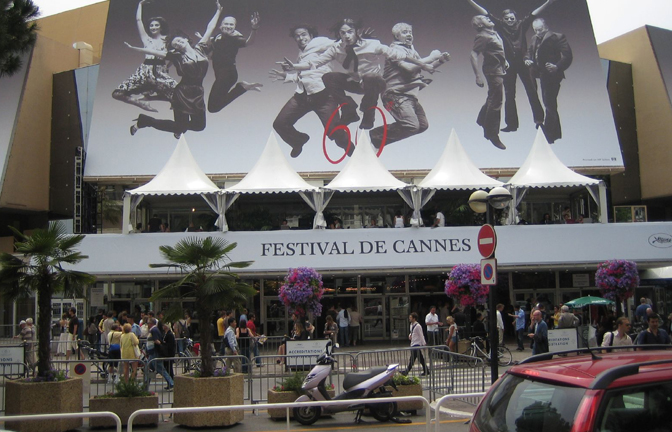
It also reminded of a strange incident during the 2007 Cannes film festival, when a friendly PR girl rang me and asked if I wanted to interview someone in a villa amongst the hills above the famous French town.
Not being too busy that night, I agreed, thinking ‘why not?’ and was intrigued as to who this person might be. A director? Producer? Actor?
As the taxi stopped outside the villa, you could almost feel the wealth and decadence in the air: palm trees peeking over walls, lights shooting into the sky and the noisy gaggle of Eurotrash inside.
My PR contact was waiting at the gates with two burly security guards hovering around her. I asked who my interviewee was, and she told me: “Ivana Trump. Donald’s ex-wife”.
Ah…, yes. I vaguely remembered her. She and her (then) husband Donald were quite the celebrity couple throughout the 1980s, widely covered in gossip columns and magazines (including this interesting piece in Spy magazine).
Donald was even referenced cryptically in Gremlins 2: The New Batch (1990) and Ivana (post-divorce) even made an appearance in The First Wives Club (1996), with the memorable line: “Remember girls: don’t get mad, get everything.”
After being ushered inside the garden party, I was directed to a path where fellow journalists were gathered and minders made sure they never went near the real action of the party which was covered by a big tent. But I was still scrambling for questions to ask her as just 30 mins earlier I had been in a hotel bar drinking quite heavily.
Then, after a few minutes, she emerged with a handler whose role was unclear, and my short ‘interview’ began (after a female showbiz hack asked who would play her in a movie.
(I come in around the 1 minute mark!):
Nothing revelatory for sure and truth be told, at the time I was not aware that Ivana was a regular showbiz fixture at Cannes (sometimes charitable, often for lines of retail items) and afterwards it remained in my audio archives. After all it was only 1 question and unrelated to film!
However, after seeing her ex-husband Donald wax lyrical on YouTube about Orson Welles’ astonishing film debut, it took me back to Cannes 2007 and how the themes of Citizen Kane endure: money, fame, power and then what?
Like Kane, Donald has amassed a fortune, gone through divorce and is currently running for political office. What lies ahead for this loud, ambitious man who is dominating the Republican primaries?
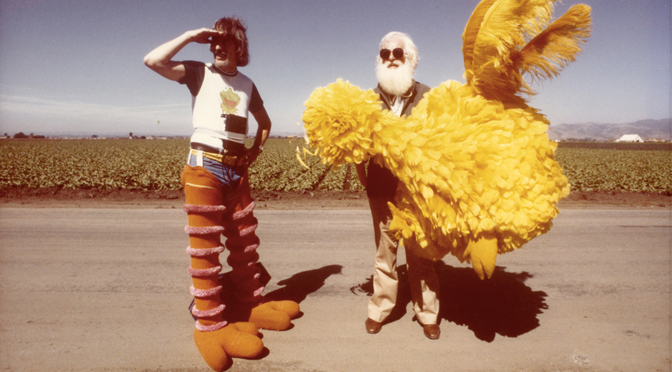
Caroll Spinney has been the voice of the iconic Sesame Street characters Big Bird and Oscar the Grouch for over 45 years and we recently spoke to him about his life and career.
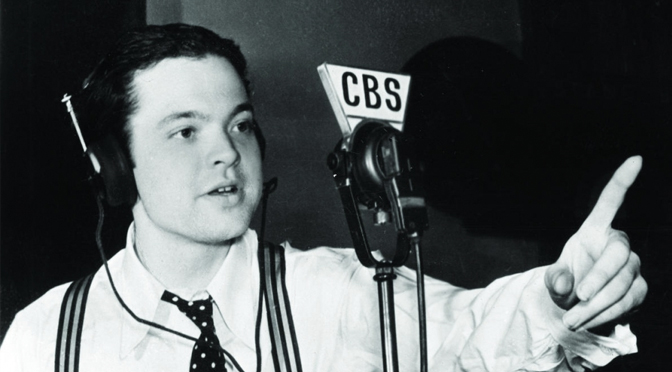
Orson Welles was the multi-talented polymath who was a pioneering figure in twentieth century theatre and film.
2015 marks the centenary of his birth in Kenosha, Wisconsin and various celebrations have been taking place across the world at festivals and cinema societies.
He is still best known for co-writing and directing Citizen Kane (1941), a landmark in film history, but also made astonishingly audacious stage productions, such as a production of Macbeth in Harlem with an all black cast.
However, it was on radio where he reached national attention in 1938 with his infamous adaptation of H.G. Wells’s novel ‘The War of the Worlds’, which was so convincing it caused widespread panic.
His Mercury Theatre group not only produced acclaimed work on stage but also on the airwaves from 1938-40 and again in 1946, with a stock company of actors including Agnes Moorehead, Joseph Cotten, Ray Collins and Helen Hayes.
The Bard was a pivotal figure in Welles’ career and various abridged productions Welles produced included Hamlet, Twelfth Night, Julius Caesar, The Merchant of Venice, Macbeth, Henry V, Romeo and Juliet, Richard II, Richard III and King Lear.
If Welles was sadly denied creative control for most of his film career, his radio work was a different story. In 1938 he was given full reign in various adaptations of literary classics, including Bram Stoker’s Dracula, Treasure Island, and The Count of Monte Cristo. The music was by Benard Herrmann, a future collaborator on Citizen Kane.
A mix of comedy, trivia, music and drama, with Agnes Moorehead as president of “the Orson Welles Swoon Club”. Guests include Nat King Cole and Kid Ory.
Before The War of the Worlds made him (in)famous, the 22 year-old prodigy funded his theatrical productions with radio work, including a year playing avenging crimefighter ‘The Shadow’.
A collection of shows made during World War II, including the liberation of Paris, the Fifth War Loan Drive and
GI Journal. A fascinating snapshot of the time, it shows a more serious side to Welles, as well as illuminating a key episode of twentieth century.
Director Peter Bogdanovich became a friend of Welles and conducted a series of audio interviews between 1969 and 1970. They discuss his life and career, including the success of Citizen Kane (1941) and later films such as The Lady from Shanghai (1947), Touch of Evil (1958), and Chimes at Midnight (1960). In total this runs to about 4 hours, but is fascinating if you are interested in the filmmaking techniques Welles pioneered and the general arc of his career.
Presented by Christopher Frayling, this 2014 documentary was broadcast on the BBC World Service. It explores audio of the conversations Welles had with his friend Henry Jaglom from 1983-85 and explores his life and career. Contributors include Welles biographer Simon Callow and film writer Peter Biskind.